Coffee, Charcoal and Conversation: Finding Common Grounds
On Sunday, I was fortunate to attend “Telling Stories through Colour and Materiality,” a masterclass presented by sculptor Mary Sibande and fashion designer Thebe Magugu at the Investec Cape Town Art Fair 2026.
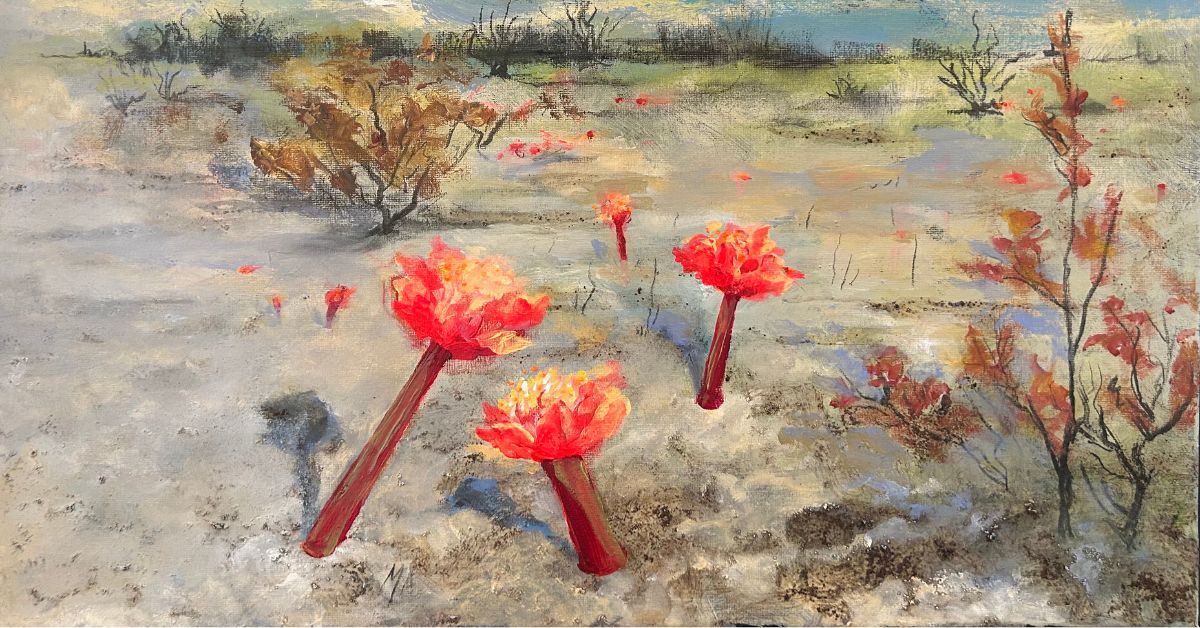
As a landscape storyteller, colour has always been central to my work. (I’ve written previously about this in Quiet Forms of Love: On Shared Journeys, Familiar Land, and the Colour of Warmth .) But recently, while working on The Ground Remembers, a post-fire Overberg landscape, I found myself frustrated by the limitations of paint alone.
Ash and scorched vegetation resist smoothness. They carry grit and fracture. As I worked, I realised I didn’t want merely to depict burnt land — I wanted the surface itself to register that abrasion. Instinctively, I began mixing coffee grounds and charcoal into the acrylic.
What I did not expect was how directly Mary and Thebe’s conversation about material would illuminate what had already begun in my own work.

A Moment of Recognition
What struck me most was the seriousness with which Mary and Thebe treat material.
For Mary, material is never secondary to concept. It determines form. A narrative may begin as an idea, but it does not automatically become a sculpture, a photograph, or a performance. The medium is not decorative — it is structural. The question becomes: what form does this story require? And that decision carries weight.
For Thebe, material becomes almost archival. He describes burying fabric with corrugated iron, allowing oxidation itself to mark the textile before it is fixed into pleated garments. The story does not sit on top of the fabric. It is embedded within it.
In both cases, material is more than surface. More than decoration. It is chosen to hold the narrative.
Sitting there, I recognised something in myself. The conversation clarified that my pull toward material density is part of a deeper enquiry into how landscape can be carried, not simply pictured.
The impulse that led me to incorporate coffee grounds and charcoal into The Ground Remembers was not about novelty. It was an attempt — instinctive at first — to let the land participate in its own telling.
After hearing these two accomplished artists articulate the relationship between substance and story, surface can no longer be treated as incidental.
Material as Resistance
The conversation also circled repeatedly back to process.
Mary spoke about letting something “stay in the oven” until it is ready — allowing time to resolve a work rather than forcing closure. Thebe, by contrast, spoke about exposing process, about allowing vulnerability and even tension to remain visible rather than smoothing it away.
Neither approach is hurried, and neither mistakes polish for integrity.
Walking the fair afterwards, I found myself drawn to works where labour was evident — not as spectacle, but as commitment.
Hannelie Taute’s thread-pierced archival photographs embody this. The stitch does not decorate the image; it interrupts it, asserting material presence over passive surface.

I was equally struck by Egyptian artist Ibrahim Khatab’s mixed media on wood — raised metallic contours holding saturated colour in place. Pigment is built up, scraped back, and reasserted. The surface carries its own history of resistance.

In a moment where seamless surfaces can be generated in seconds, these works assert something slower: time, resistance, irreversibility.
When Material Becomes Cultural Again
Beyond individual practices, the fair signalled something broader.
Decades ago, while visiting Beatrix Potter’s home, I learned — with some sadness — that sheep were being shorn purely for their own comfort because there was no economic demand for wool. The fibre had lost its cultural value and was slipping into redundancy.
That memory has lingered, particularly as conversations around land stewardship, sustainability, and energy have intensified.
It was therefore striking to see how, in 2026, the installation Rewoolution framed wool not as nostalgic craft, but as ecological and cultural material. Draped textiles. Visible seams. Raw fibre, unapologetically tactile.
The installation spoke of renewal — of land, animal fibre, and collective making. It was a reclaiming of wool as substance: land, labour, community made tangible.

As someone whose practice has repeatedly returned to sheep — sometimes to my own amusement — I have long been aware of how strongly people respond to them. A surprising number speak of them with affection, even longing. Sheep seem to awaken something — a memory of shared rhythms, of tending and being tended, of lives once lived in closer relationship with land and animal.
There is something archetypal in that attachment — a reminder that human life has long been intertwined with animal life and fibre.
Seen in that light, the renewed seriousness around material does not feel like trend. It feels like return.
Staying With the Ground
So what will I take from this year’s Investec Cape Town Art Fair?
I firmly believe we become open to, and find, the answers we need (sometimes even before we can articulate our questions) when we “do the work”.
I have learnt that to get what I need from my practice, I need to restrain myself from intellectualizing too much upfront. If not, I risk absorbing the stories of others and lose my own.
For me, instinct and exposure are complementary and intertwined. But I need to pay attention first to where instinct has delivered me.
In The Ground Remembers, the paintbrush lilies (Haemanthus coccineus) have taken on an air of defiance.
Fire here is not only destruction. It is clearing. It strips away excess.
When the paintbrush lilies break through, they are not decorative, despite their luminosity. Their saturation against the blackened field is not optimism. It is insistence.
Defiance, here, feels less like rebellion and more like remembrance.
The ground remembers.
Not nostalgia, but recognition — of what persists beneath damage, beneath surface, beneath performance. In painting them, I am not inventing resilience; I am returning to something I already know to be true.
*The Ground Remembers is not yet available for sale. I am considering how it should be framed, and what direction this material enquiry may take. If the work resonates with you, I welcome a conversation.